
Service learning opens doors to community engagement and career pathways
June 01, 2026
For students at LSU School of Veterinary Medicine, learning extends beyond classrooms and clinics. It happens by design in animal shelters and rescues, on farms, in museums, and wherever there is a perspective to be gained and a community to serve. Over the past two decades, service learning has emerged as a powerful approach to education, applying classroom knowledge to make meaningful, community-driven contributions and open career pathways.
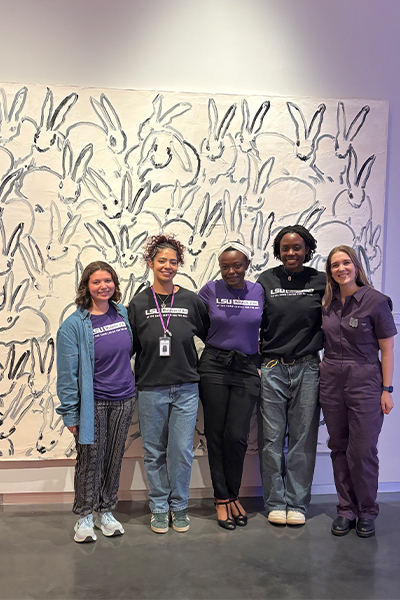
Service learning doesn’t just teach future veterinarians—it reshapes how they see their role in the world. Pictured (center) is LSU Vet Med DVM student Shadayah Muhammad, who shared fascinating animal facts along with insights from other LSU students during an LSU Museum of Art gallery tour in October 2025.
Rather than volunteering based solely on what a participant wants to offer, service learning emphasizes immersion in a community and responding to needs identified by that community. This model allows students to learn through hands-on experiences while contributing in meaningful ways.
At LSU Vet Med, the first-year curriculum includes experiential learning where students are encouraged to participate in activities that address animal-related needs in their communities. These experiences may include volunteering with animal organizations, working alongside veterinarians, or developing educational programs that share animal-based knowledge with the public, depending on the semester. The goal is to create a mutually beneficial partnership: students gain practical experience and professional insight while communities benefit from their time, enthusiasm, and growing expertise.
Students have created some amazing experiences and have had an important impact in Baton Rouge and beyond. Locally, students have volunteered at BREC’s Baton Rouge Zoo, Cat Haven, Companion Animal Alliance, and animal rescues. We encourage them to immerse themselves with species that they haven’t worked with before and to explore new areas of veterinary medicine. Others have chosen to complete projects in their hometowns, expanding the reach of the program to communities across the country—from California to Puerto Rico.
Many students also use this opportunity to explore different areas of veterinary medicine through shadowing experiences. They have spent time in both small and large animal hospitals, observing clinical practice and client communication. Some have explored food animal medicine and learned how working dairies operate, while others have examined the veterinarian’s essential role in food safety and public health.
What began as an open-ended opportunity for students to design their own projects has grown into a course that challenges them to think more intentionally about their future careers. One key theme we now emphasize is that veterinarians become educators from the moment they graduate. Every client interaction involves teaching: explaining diagnoses, treatments, and preventive care in ways that are understandable.
Teaching various age groups has become a central component of many projects. Students have introduced preschool children to basic concepts such as animal behavior and the importance of keeping pets healthy. Others have worked with middle school students to explain parasites or helped high school classes review anatomy while discussing preparation for college. College audiences have participated in sessions about veterinary school admissions and professional pathways. Students have also participated in therapeutic animal programs, including hippotherapy, supporting children and adults in the community through animal-assisted activities.
At the end of the course, students write reflections and express how transformative the experience can be. Many students begin the course unsure of what to expect but finish with a deeper appreciation for the role veterinarians play in education and community engagement.
One student wrote, “I have found that everything I’ve learned is more significant than I would have originally guessed when starting the course. It has pushed me to explore more options in the veterinary world.” Another wrote about how impactful teaching was during their experience and being able to combine animals, teaching and philanthropy was one of their favorite things. A third shared that it was “like touching grass” when he was able to work with horses and help the owner manage laminitis in a sanctuary. He said that getting out of the classroom for a real-world experience offered a reminder of his ‘why’ for being in vet school. One student participated in a collaborative opportunity with the LSU Museum of Art, helping lead a special tour where he discussed the animals depicted in the artwork while art students discussed the artwork and artist.
As students continue to challenge themselves through community involvement, we are creating opportunities for them to develop lasting habits of service. By valuing community engagement early in their careers, these future veterinarians may one day welcome students into their own practices and encourage the same spirit of learning, curiosity, and service.