


How much Methane Comes from Sugar Cane Waste?
December 03, 2025
Louisiana’s sugar mills churn out 3 million tons of a byproduct called bagasse every year. The mills burn most of it for energy, but an estimated 10-30% rots in fields near the factories, taking valuable crop land out of production while emitting as much methane as a small-to-medium-sized landfill.
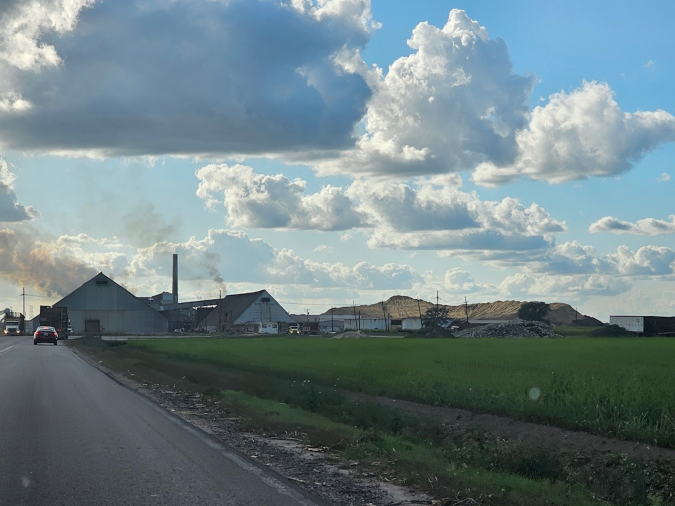
Mounds of bagasse, a waste product generated by processing sugar cane, pile up around a sugar mill.
“Our presentation at AGU will make the case there are likely better options,” said Anurag Mandalika, assistant research professor at the LSU Center for Energy Studies.
Those include:
- Converting the bagasse to diesel, gasoline, or jet fuel. In July, an LSU-led team of researchers—Mandalika is a member—won a $7 million National Science Foundation grant to develop the technology.
- Converting the bagasse to pellets that can be burned to generate electricity at biomass power plants.
- Processing the bagasse to lock the carbon in, prior to storage for long-term carbon dioxide removal.
Mandalika does not know which option is best. Figuring out the best potential use would require a dedicated study focused on the technoeconomics and a life cycle analysis.
“The Center for Energy Studies doesn’t advocate for one solution over another,” Mandalika said. “It's not so simple. You would have to factor in the costs of any particular technology, its associated emissions, state and federal economic incentives, and a number of other variables. There would need to be a dedicated study to look at best potential use cases.”
Mandalika’s work on bagasse and methane emissions was limited to six weeks of data, which was funded through a grant from Carboniferous, Inc. A longer-term study is needed to more accurately determine the amount of methane that bagasse emits. Bagasse that has been decomposing for a year generates far more methane than the bagasse just processed by a sugar mill.
LSU at AGU25
Join more than 250 LSU researchers at the premier Earth and space science conference and shape the future of our planet—the Annual American Geological Union (AGU) Meeting in New Orleans on December 15-19, 2025. Through visible, solutions-driven scholarship, LSU plays a leading role in shaping the conversations that matter at AGU.