News
Center Releases Report on Economic Implications of Carbon Capture and Sequestration
Projects for Louisiana
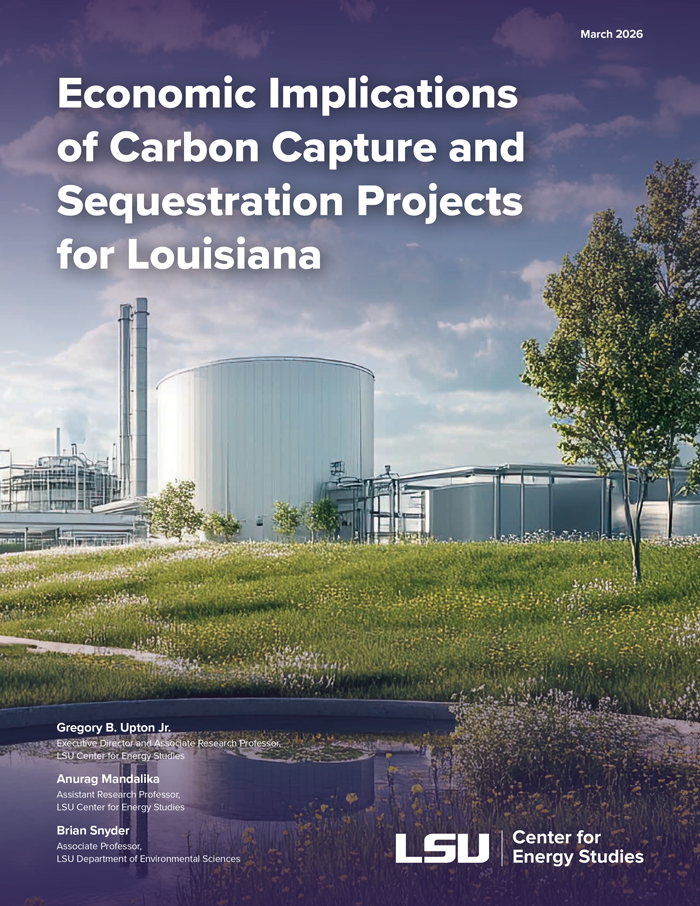
Gregory B. Upton, LSU Center for Energy Studies, along with Anurag Mandalika, LSU
Center for Energy Studies and Brian Snyder, LSU Department of Environmental Sciences
have co-authored a report titled, "Economic Implications of Carbon Capture and Sequestration
Projects for Louisiana".
This report presents estimates of the potential economic activity associated with
carbon capture and sequestration (CCS) projects in Louisiana. Using publicly announced
projects and associated infrastructure requirements, the analysis compiles investment,
employment, and output estimates based on the modeling framework described in the
report.
The analysis identifies 13 announced projects with a carbon capture component with
investments totaling approximately $48 billion. In addition, the study identifies
33 existing facilities as practically feasible for CO₂ capture that currently employ
approximately 4,200 workers. The report also estimates the pipeline infrastructure
and Class VI sequestration wells required to sequester approximately 46 million metric
tons of CO₂ per year from these announced and existing facilities.
Read More
Center Releases White Paper on Carbon Sequestration Fee Structures

Keith Hall, LSU Mineral Law Center and John P. Laborde Energy Law Center, and Greg
Upton Jr., LSU Center for Energy Studies, along with Daniel Keniston, LSU E. J. Ourso
College of Business, and Joanna Walker, LSU Center for Energy Studies have co-authored
a white paper titled, "Legal and Regulatory Considerations for Carbon Sequestration
Fee Structures".
This white paper examines the legal and regulatory issues that arise when developing
carbon capture and storage (CCS) projects, with a focus on Louisiana and comparisons
to broader U.S. practices. Because CCS requires injecting carbon dioxide deep underground,
operators must secure rights to use subsurface pore space—an area of law that is still
evolving and differs in key ways from traditional oil and gas activity.
The paper explains why CCS developers need legal rights to pore space, touching on
foundational property law concepts like ad coelum and the risk of trespass if injected CO₂ migrates beyond a project boundary. It reviews the types of agreements
used to obtain pore space rights (e.g., leases, servitudes) and the compensation models
associated with them. It also discusses statutory tools—such as unitization and eminent domain—that may be used when private agreements with all landowners cannot be reached.
Read the White Paper.
LSU Energy Institute Names Tyler Gray Director of Energy Innovation
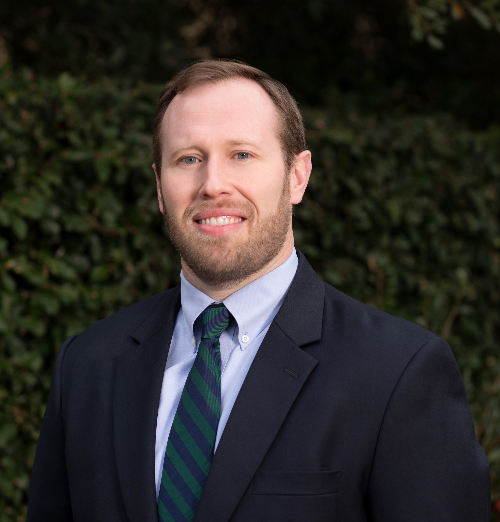
The LSU Energy Institute has named Tyler Gray as its inaugural director of energy
innovation, a key leadership role within LSU’s expanding energy research and policy
enterprise. Gray’s appointment marks an important step in LSU’s continued move to
align energy-focused units under a single institute to serve Louisiana’s evolving
energy economy.
Gray previously served as secretary of the Louisiana Department of Conservation and
Energy since the inauguration of Governor Jeff Landry. During his tenure in the Governor’s
cabinet, Gray spearheaded efforts to modernize Louisiana’s energy and natural resource
governance. His move to LSU reinforces a shared commitment between higher education,
industry, and government to connect scholarly research with practical implementation.
“Under my administration, we’ve modernized how Louisiana manages energy and natural
resources—clear roles, better oversight, and a stronger foundation—and Tyler was central
to that effort,” Governor Jeff Landry said. “His move to the Energy Institute will
continue building a cohesive, trusted pipeline from research to execution so projects
are safe, technically sound, and delivered with confidence. I’m asking everyone—industry,
higher education, and agencies—to row in the same direction. One team. This is an
opportunity to align talent and research to Louisiana’s needs and move faster on the
projects that matter to families across our state.”
Read the full Press Release.
Center Releases White Paper on Orphan and Idle Wells in Louisiana
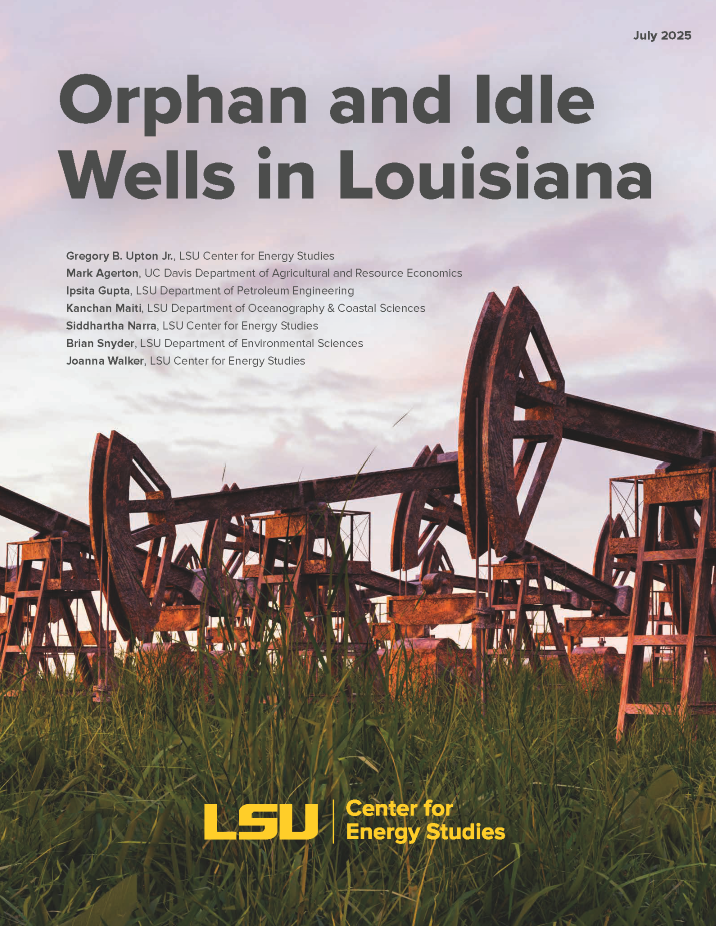
Gregory B. Upton Jr., LSU Center for Energy Studies; Mark Agerton, UC Davis Department
of Agricultural and Resource Economics; Ipsita Gupta, LSU Department of Petroleum
Engineering; Kanchan Maiti, LSU Department of Oceanography & Coastal Sciences; Siddhartha
Narra, LSU Center for Energy Studies; Brian Snyder, LSU Department of Environmental
Sciences; and Joanna Walker, LSU Center for Energy Studies, have co-authored a report
titled "Orphan and Idle Wells in Louisiana," published in July 2025.
Researchers at LSU were tasked by the Louisiana Department of Energy and Natural Resources
(DENR) to estimate the costs of plugging orphan and idle wells and assess methane
emissions from orphan wells. This report provides background on the Louisiana Oilfield
Site Restoration (OSR) program created in 1993 and estimates the total cost to plug
orphan and idle wells. In 2023, the OSR Program’s efforts were augmented by federal
funds from the Infrastructure Investment and Jobs Act (IIJA), which allocated $4.7
billion for orphan well site plugging, remediation, and restoration across the U.S.
Louisiana has received an initial $25 million grant and anticipates receiving approximately
$156 million in additional grant funds over the next several years.
Read more
Center Releases White Paper on the Production and Potential for Biofuels in Louisiana

Center for Energy Studies Assistant Professor of Research, Dr. Anurag Mandalika, has
authored a white paper titled, “The Biofuels Landscape in Louisiana”.
This paper discusses biomass types and availability in the state, drawing from an
analysis of the US Department of Energy’s Billion Ton 23 report, followed by an assessment
of current and potential future biofuels production in Louisiana. Louisiana leads
the nation in the production of renewable diesel, and biofuels contribute ~4.2% to
primary energy production in the state. Deployment of announced biofuels projects
has the potential to increase this contribution to ~9.2%. Production of sustainable
aviation fuel (SAF) is likely to see an increase in the state with several project
announcements focusing on this fuel.
Read more
Center Announces Launch of Louisiana Energy News Online Resource
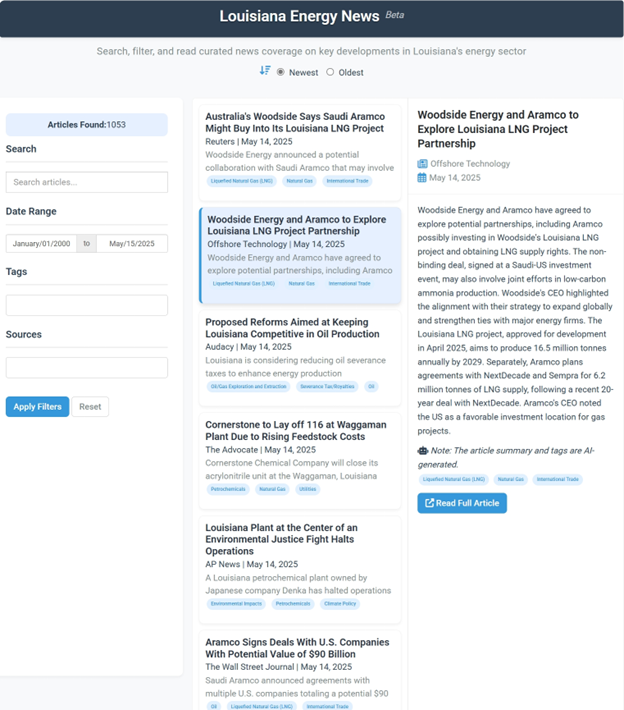
The Center is pleased to announce the launch of a new online application — the Louisiana
Energy News. This tool was developed in response to Act 727 of the 2024 Regular Legislative
Session, which calls upon CES, in cooperation with the Office of Energy within the
Louisiana Department of Energy and Natural Resources, to create and maintain a central,
comprehensive, and unified energy data and information program for the state. This
online resource centralizes historical energy sector news, providing a comprehensive
view of developments shaping our state's energy landscape and receives daily updates
to ensure stakeholders have timely access to important information.
Access the Louisiana Energy News online application here.
Read more
Center Releases White Paper on Potential for Hydrogen in Louisiana
Dr. Anurag Mandalika, Assistant Professor of Research at the Center for Energy Studies,
and Dr. Greg Upton Jr., Executive Director and Associate Professor of Research, along
with Dr. Brian Snyder, Professor of Environmental Science, and Dr. John Flake, Professor
of Chemical Engineering, at LSU have co-authored a white paper titled "The Potential
for Hydrogen in Louisiana.”
This paper discusses the different types of hydrogen, their production processes,
and current and potential future uses in Louisiana while considering its potential
as a low-carbon emission fuel. Low carbon or “clean hydrogen” is the focus of the
Internal Revenue Service (IRS) Section 45V production tax credit which has led to
additional interest in hydrogen production in Louisiana.
The Greater New Orleans Development Foundation (GNODF) commissioned LSU-CES to study
the potential for hydrogen consumption in Louisiana through the H2theFuture initiative.
Read more
Center Releases White Paper on Economic Implications of Offshore Wind Scenarios
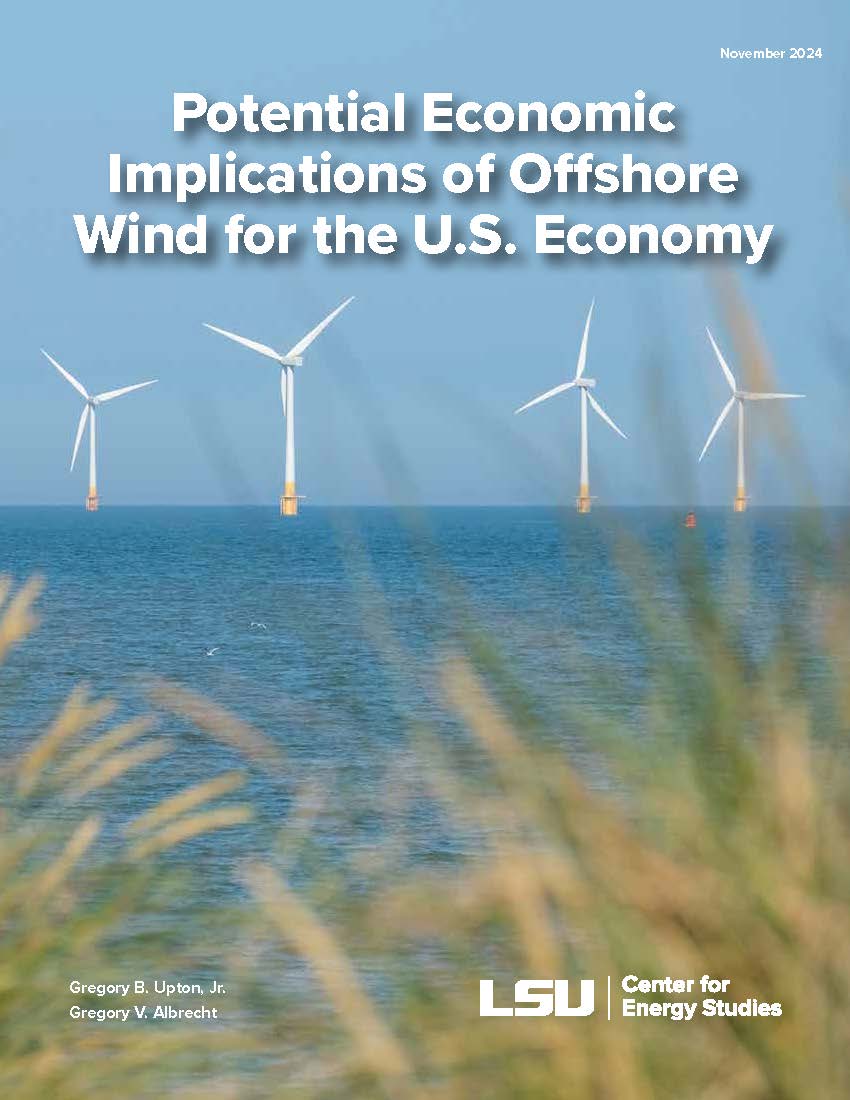 Center for Energy Studies Executive Director Dr. Greg Upton, Jr., and Research Fellow
Gregory Albrecht, in partnership with Citizens for Responsible Energy Solutions (CRES)
Forum, have prepared a white paper titled “Potential Economic Implications of Offshore
Wind for the U.S. Economy.” The paper considers the economic implications of two potential
U.S. offshore wind build-out scenarios, the 2023 Annual Energy Outlook (AEO) projection
and the National Renewable Energy Laboratory (NREL) projection, including job creation
and GDP. The economic impact analysis of both scenarios indicates that development
of the industry could support a substantial number of jobs, earnings, and overall
domestic product within the U.S., during construction itself and from operations of
the built-out capacity.
Center for Energy Studies Executive Director Dr. Greg Upton, Jr., and Research Fellow
Gregory Albrecht, in partnership with Citizens for Responsible Energy Solutions (CRES)
Forum, have prepared a white paper titled “Potential Economic Implications of Offshore
Wind for the U.S. Economy.” The paper considers the economic implications of two potential
U.S. offshore wind build-out scenarios, the 2023 Annual Energy Outlook (AEO) projection
and the National Renewable Energy Laboratory (NREL) projection, including job creation
and GDP. The economic impact analysis of both scenarios indicates that development
of the industry could support a substantial number of jobs, earnings, and overall
domestic product within the U.S., during construction itself and from operations of
the built-out capacity.
Read more


